
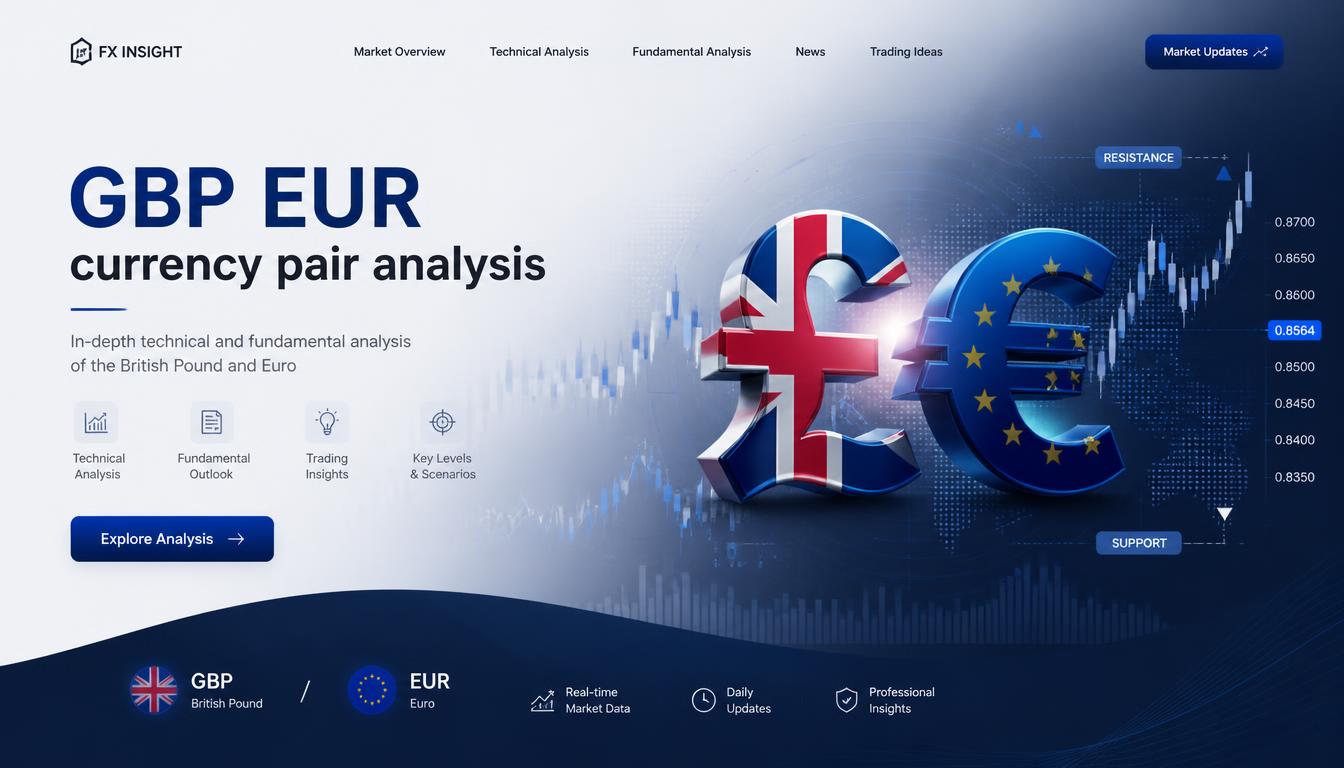

The British Pound to Euro (GBP/EUR) currency pair, sometimes known by the nickname "Chunnel" among professional traders (referring to the Channel Tunnel connecting Britain and Europe), is one of the most important, oldest, and highest-volume "Cross Pairs" in the Forex market.
Since the US Dollar is not directly involved in this currency pair, analyzing it requires a pure focus on the internal dynamics of the two large, neighboring economies of the European continent. Below, we examine the characteristics and key factors influencing this currency pair:
1. Economic Importance and Position
This currency pair represents the confrontation between the second and third largest economies in Europe (Britain and the Eurozone). The UK and the European Union are very close trading partners, so any change in the trade balance, customs regulations, or political relations between London and Brussels has a direct impact on the value of this currency pair.
2. Key Fundamental Factors
- Central Bank Policies (BoE vs. ECB): The most important price driver is the interest rate differential between the Bank of England (BoE) and the European Central Bank (ECB). If the Bank of England raises interest rates faster or more aggressively than the ECB to curb inflation, the Pound becomes more attractive, and the GBP/EUR pair moves upward (and vice versa).
- Political Factors and the Brexit Legacy: Although years have passed since Britain's official exit from the EU, trade relations, new agreements, and any diplomatic tensions between London and Brussels can still cause sudden fluctuations in this currency pair. Domestic political instability in the UK (such as frequent changes in the Prime Minister) usually works to the detriment of the Pound.
- Economic Data: The release of inflation statistics (CPI), Gross Domestic Product (GDP) growth, and Purchasing Managers' Index (PMI) figures in both regions is closely monitored. Historically, inflation in the UK tends to be "stickier" than in the Eurozone, putting more pressure on the Bank of England to keep interest rates high.
3. Trading Characteristics (Technical and Market)
- Volatility: Generally, the daily volatility of GBP/EUR is lower than that of major currency pairs like GBP/USD or EUR/USD. This makes it attractive for traders looking for calmer, trend-following movements. However, it can experience explosive moves on days when interest rate decisions or major political news are released.
- Liquidity and Spread: As a cross currency pair (Minor/Cross), its liquidity is lower than that of major pairs. Consequently, brokers usually assign a slightly higher spread to it.
- Best Trading Time: The peak activity and best time to trade this currency pair is during the London trading session (morning to noon, Iran time). During this window, both the UK financial markets and primary European markets (such as Frankfurt and Paris) are open, and the highest volume of orders is executed.
4. Mathematical Correlation (Pro Tip)
Mathematically, the price of GBP/EUR is derived by dividing the prices of two major currency pairs:
Important Strategic Note: If the US Dollar strengthens significantly due to global reasons (e.g., a geopolitical crisis), both GBP/USD and EUR/USD will fall. In this scenario, the Dollar's impact on GBP/EUR might be neutralized, unless investors prefer one of these two currencies (Pound or Euro) as a "safer haven" under those specific conditions (typically, the Euro tends to act slightly more resiliently than the Pound during European crises).
Conclusion
Successful GBP/EUR traders pay less attention to US news and instead focus on the "economic divergences" between the UK and the Eurozone. They constantly compare the economic calendars of both regions to see which central bank will be forced to adopt more aggressive tightening or easing policies.
Would you like to discuss specific trading strategies (such as trading based on interest rate divergence or price action in this currency pair) in more detail?
Buy/Sell Signals Using Bollinger Bands 20
The Bollinger Band chart (from the Volatility Indicators category) is an analytical tool used to evaluate market conditions.

📰 NEWS
There are always other effective factors on crypto market prices. Decide to buy or sell calmly and avoid any haste. Before buying or selling any token, check the Bitcoin analysis once. The most important issue is investment security.
If charts are not visible, please update your browser or use the latest version of Google Chrome.